
Construction
Slow Season Marketing Ideas for Construction Companies
Construction slow season marketing works best when it starts before the slowdown, in September and October, and aims at the work that keeps going in winter.

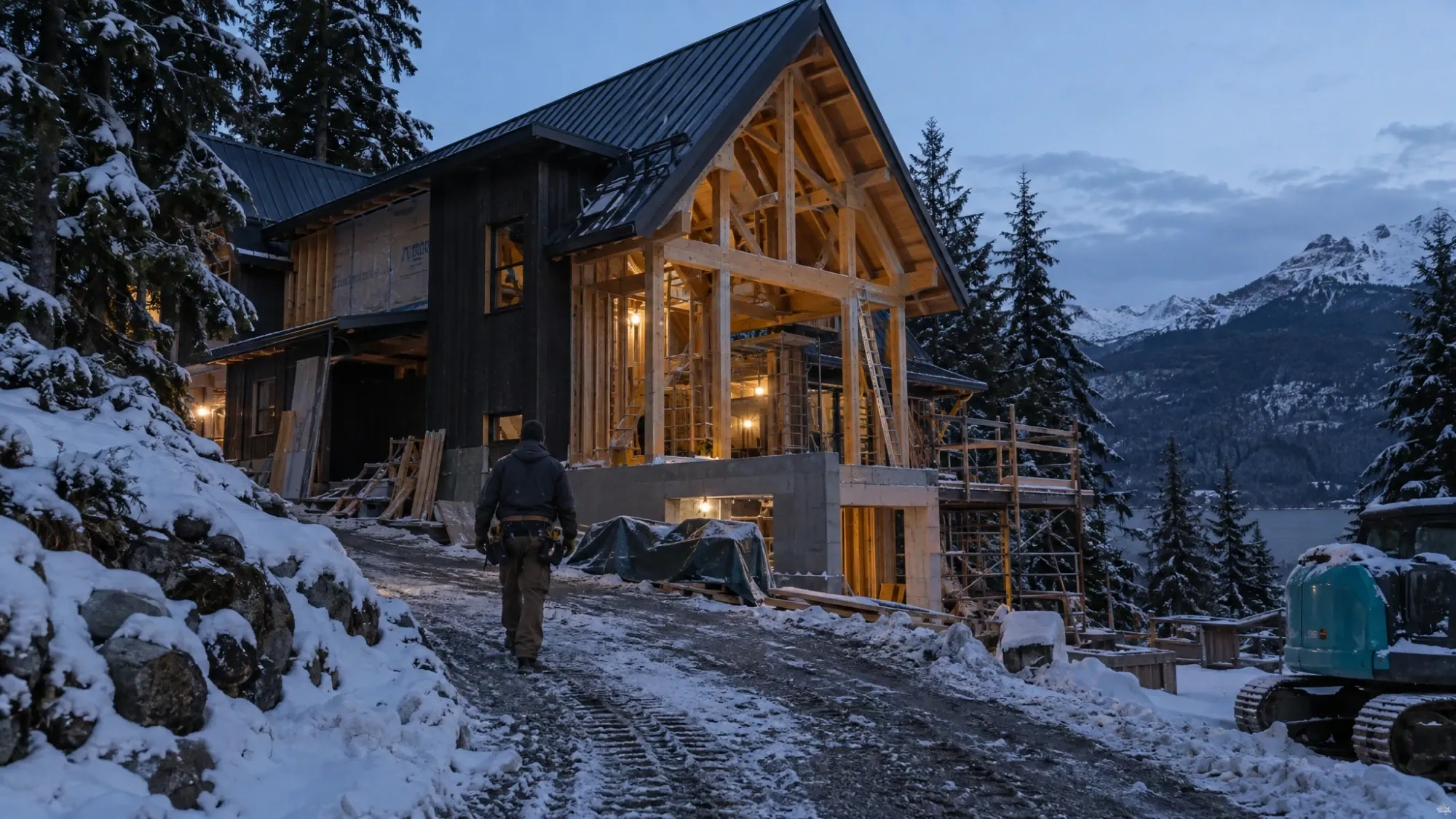
When is the construction slow season in Canada?
For most of the country, January to March, but it depends on where you build. Construction employment falls about 10% from August to January nationally. BC barely slows, at about 4%, while New Brunswick and Newfoundland and Labrador drop more than 20%. Start building your pipeline in the fall, before the dip.
| Region | Busiest month | Slowest month | Drop | Months more than 7% below the peak |
|---|---|---|---|---|
| British Columbia | June | January | 4% | None |
| Ontario | August | January | 9% | January and February |
| Alberta | August | January | 12% | January to March |
| Manitoba | August | March | 12% | December to April |
| Nova Scotia | August | April | 13% | January to May |
| Saskatchewan | August | March | 14% | January to April |
| Newfoundland and Labrador | July | March | 23% | November to May |
| New Brunswick | August | February | 24% | November to June |
| Canada | August | January | 10% | January to March |
About 168,000 fewer people work in construction in an average January than in August1, mostly in exterior work. Interior work and planning carry on.
Which construction slow season marketing ideas pay off fastest?
The cheapest and fastest is calling back every unsold quote. Then sell design and pre-construction work for spring starts, pre-book spring dates and check in with past clients. Paid ads for indoor projects work within weeks; project pages, photos and certificates pay off over the year.
| Rank | Idea | Cost (CAD) | Payoff time | Effort | Best for |
|---|---|---|---|---|---|
| 1 | Call back unsold quotes, then follow up monthly | $0 | Days | Low | Everyone |
| 2 | Sell design and pre-construction for spring starts | $0 | 1 to 3 months | Medium | Custom homes, additions |
| 3 | Pre-book spring starts | $0 to $500 | Spring | Medium | Everyone |
| 4 | Past-client check-in, referral and review ask | $0 to $100 | 1 to 3 months | Low | Everyone |
| 5 | Ads for indoor projects | $1,000 to $2,500 a month | Weeks | Low | Prairies, Ontario, Atlantic |
| 6 | Free lot checks for suites and multiplexes | $0 | 1 to 3 months | Medium | BC |
| 7 | Fix your Google profile and home page | $0 | 1 to 3 months | Low | Everyone |
| 8 | Lunch with architects, designers and realtors | $50 to $150 a lunch | 1 to 6 months | Medium | Everyone |
| 9 | A home show or community event | Booth fees vary by show | 1 to 4 months | High | Renovators, custom builders |
| 10 | Shoot your finished projects | $692 to $4,000 for photos | 3 to 6 months | Medium | Everyone |
| 11 | A page for every project you finished this year | Your time, or an SEO plan | 3 to 9 months | Medium | Everyone |
| 12 | Prequalify for bids and get certified | $0 to a few thousand | 3 to 12 months | High | Commercial, new homes |
How do you win construction work this winter?
Go back to the people who already asked you for a price, sell the design stage of spring projects, and advertise the work that doesn't stop for frost: basements, kitchens and suites. These bring paid work or signed projects within weeks, while your crews still have room.
1. Call back unsold quotes, then follow up monthly
Pull every unsold quote from the last 12 months and call each one in December or January. Ask if they still plan to do it, offer to update the price and mention spring dates. Then send the rest a monthly email or text with a finished project like theirs. If you email, make sure you have their consent under Canada's anti-spam law3.
2. Sell design and pre-construction for spring starts
A custom home or addition needs drawings, engineering, a permit and a price before it starts. Offer a paid pre-construction package in winter and credit the fee toward the build. Only 35% of construction websites explain their process and 4% say how they price4, so a page that walks through this stage sets you apart.
5. Ads for indoor projects
HomeStars puts a full basement finish at $25,000 to $75,000 and a kitchen at $15,000 to $60,0005. Run a Facebook campaign from October to March with a short video of a finished basement or kitchen and a free walk-through as the offer. A contractor lead from Facebook typically costs about $616. Our Facebook ads guide for construction companies has the ad ideas.
6. Free lot checks for suites and multiplexes (BC)
Most single-family and duplex lots in larger BC municipalities must now allow three or four units, and six near frequent transit7. A free lot check (what can I build, roughly what will it cost) brings in owners planning the next year or two. Only 13% of BC construction websites have a suite or multiplex page4.
How do you fill the spring calendar?
Lock in spring starts before March, check in with past clients and referral partners, and fix the basics on your Google profile and website. A full calendar by March lets you pick your jobs instead of taking whatever calls.
3. Pre-book spring starts
Offer this: book a spring start by the end of February and keep this winter's price, with a deposit to hold the date. HomeStars notes contractors often charge more in spring and summer5, which makes the offer real.
4. Past-client check-in, referral and review ask
Text every client from the last two years with a photo of a recent job and ask whether they know anyone planning a project. Then ask for a Google review with your direct link8. The top 3 construction companies in our 21-market Google Maps snapshot had a median of just 35 reviews9, and 62% of homeowners want more than 25 before hiring10. Ask every client, not only the happy ones; Google bans paying for reviews and asking only for positive ones11.
7. Fix your Google profile and home page
Set the right primary category, and put a phone number, quote button and your Google rating in the first phone screen. Only 29% of construction websites show a phone number before scrolling, 44% a quote button and 16% their rating4.
8. Lunch with architects, designers and realtors
They plan their year in winter too. Bring last year's photos and ask what's coming.
9. A home show or community event
Winter home shows reach homeowners who are planning. Bring a finished project on a screen, a price range and a way to book a walk-through on the spot.
What should you build in the slow months for next year?
Content and credentials that keep paying off: photos and video of finished projects, a page for each project you completed, and the prequalification and certificates commercial clients ask for. These take time, which is exactly what winter gives you.
10. Shoot your finished projects
Book a photographer for your best three to five jobs. Photo shoots ran $692 to $4,000 and video $1,100 to $14,999 in our agency price study2.
11. A page for every project you finished this year
One page per project with the town, scope, timeline and photos. Google can't read a gallery with no words. Our SEO guide for construction companies covers which pages to build first.
12. Prequalify for bids and get certified
Register on CanadaBuys and your provincial tender sites12, and send your prequalification package to general contractors. Start any certificate you're missing: many general contractors require a recognized safety program such as COR, and BC holders may get 10% in annual incentive payments from WorkSafeBC13. Renovators can join RenoMark14.
What should construction companies avoid in the slow season?
Don't cut prices across the board, go quiet, or take any job just to stay busy. Discounts teach clients to wait for winter; silence means starting from zero in March; and a bad-fit winter job can tie up your best crew when the good spring projects call. Lock a spring price instead, and keep your marketing running.
If you'd rather have a winter plan built for you, see our advertising and lead generation or construction marketing. The website data is in our construction website study.
Questions contractors ask
When is the slow season for construction in Canada?
For most of the country, January to March. Construction employment falls about 10% from August to January nationally, 12% in Alberta and about 24% in New Brunswick. In BC it dips only about 4%1.
How can construction companies increase sales in the slow season?
Call back every unsold quote, sell design and pre-construction work for spring starts, push indoor projects like basements and kitchens, and pre-book spring dates with a deposit.
Should construction companies advertise in winter?
Yes, but change the message: indoor projects, design consultations and spring bookings. Winter is when many homeowners plan the projects that start in spring.
When should I start slow season marketing?
In September or October, while you're still busy. The leads you start then become the spring projects you sign in January.
How we put this together
- Construction jobs lost from August to January
- About 10% nationally
- BC's winter dip
- About 4%
- Ideas ranked
- 12, with cost, payoff and effort
- Updated
- October 11, 2026
The seasonal figures are our analysis of Statistics Canada's Labour Force Survey, Table 14-10-0022-01: construction employment, not adjusted for season, averaged for each month over 2023 to 2025, and compared with the busiest month in each province1. Prince Edward Island and Quebec are left out because they aren't in our study's markets. Website figures come from our test of 133 Canadian construction websites4, and the review bar from our Google Maps snapshot of 530 construction listings9. Project costs are HomeStars' national ranges5; photo and video prices come from our study of 69 agencies2. The ranking and other cost estimates are Debut Marketing's. The top 3 Google results for "construction slow season marketing" were reviewed on October 11, 2026.
Cite this page
Striemer, E. (2026, October 11). Slow Season Marketing Ideas for Construction Companies. Debut Marketing. https://debutmarketing.ca/construction-slow-season-marketing
The numbers on this page are Debut Marketing's 2026 findings. We combined our own campaign data with the studies, ad platforms and agencies listed under Sources, took the typical figure for each number and put it in Canadian dollars. You're welcome to use them: please credit Debut Marketing and link to this page.
Sources
- 1 Statistics Canada (2023). Labour force characteristics by industry, monthly, unadjusted for seasonality (Table 14-10-0022-01). Construction employment, January 2023 to December 2025 (Debut analysis).
- 2 Debut Marketing (2026). Debut Marketing Agency Price Study 2026. Published prices of 69 marketing agencies (35 Canadian) and 14 photo, video and drone studios, October 4 and 5, 2026.
- 3 Government of Canada. Canada's anti-spam legislation. Businesses need consent before sending commercial electronic messages.
- 4 Debut Marketing (2026). Debut Trades Index: Construction Website Statistics 2026. 133 Canadian construction companies scored on their websites and Google profiles in 21 markets, October 6 to 7, 2026 (report DTI-Construction-2026-v1).
- 5 HomeStars (2026). How Much Does a Home Renovation Cost in Canada 2026?. Updated August 21, 2026. Kitchen $15,000 to $60,000; bathroom $8,000 to $25,000; basement $25,000 to $75,000; whole home $100,000 to $300,000+.
- 6 Debut Marketing (2026). Facebook Ads for Construction Companies. 2026. Contractor Facebook lead about $61 CAD, median of four sources (own aggregate).
- 7 Government of BC. Small-scale, multi-unit housing. BC rules that allow 3 to 6 homes on many single-family lots
- 8 Google Business Profile Help. Tips to get more reviews. Asking customers to leave a review through a Google link or QR code
- 9 Debut Marketing (2026). Construction Companies on Google Maps 2026. Google Maps search for "construction company" in 21 Canadian markets, October 7, 2026: 530 organic listings.
- 10 Debut Marketing (2026). Debut Marketing Contractor Search Study 2026. 1,113 Canadian homeowners who had searched online for a local contractor in the last three months.
- 11 Google Maps user contributed content policy. Prohibited and restricted content. Fake engagement and rating manipulation.
- 12 CanadaBuys. Tender opportunities. Government of Canada. Browsable without an account, with a Construction category.
- 13 BC Construction Safety Alliance. COR program. Many general contractors require subcontractors to have a recognized safety program to bid.
- 14 RenoMark. RenoMark. Delivered with the Canadian Home Builders' Association and local associations.
Keep reading
-
 Construction Website Statistics 2026 133 Canadian construction companies scored on their websites and Google profiles: the grades, the gaps and the fixes. Read it
 -
 Google Ads for Construction Companies What a construction lead costs in CAD, campaigns by project type, and how to track signed jobs. Read it
 -
 Facebook Ads for Construction Companies What a Facebook lead costs next to Google, three construction ad ideas, and the follow-up that books site visits. Read it